

EU India session at the European Parliament Sets the Course for a New Era in EU–India Relations

Updated: Jun 16
The Europe India Centre for Business & Industry (EICBI) successfully organised the 7th EU–India Leaders Conference in Brussels on 9 June 2026, with sessions held at the European Parliament and other locations under the theme “Strengthening Trade & Sustainable Growth Partnerships.” The conference brought together Members of the European Parliament, policymakers, diplomats, business leaders, academics, and industry experts to discuss the future of the EU–India strategic partnership and the opportunities emerging from a rapidly evolving global landscape.
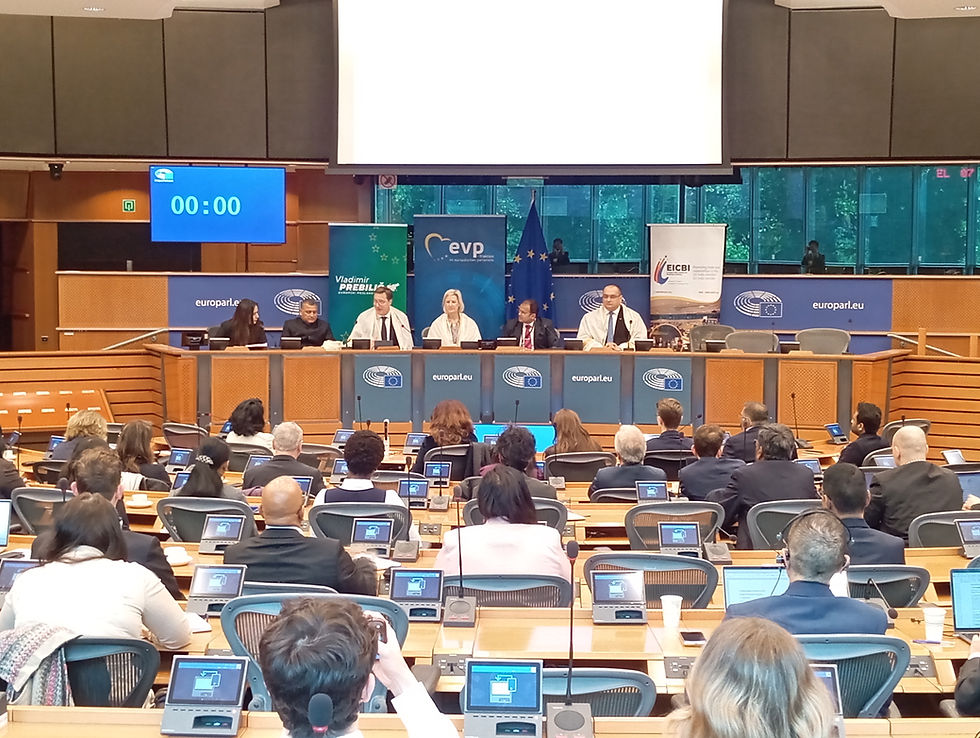
This year's engagements took place across three locations in Brussels, bringing together Members of Parliament, diplomats, business leaders, policymakers, industry stakeholders, and emerging leaders to advance dialogue across the EU–India corridor. The programme was structured around three key sessions: Session 1 – European Parliament Session; Session 2 – Invest in Austria; and Session 3 – EU–India FTA Discussion in partnership with India Salon Brussels.
Session 1 - EU Parliament
The session at the European Parliament brought together Members of the European Parliament from Germany, Slovenia, Romania, and Austria, alongside Member of Parliament of India Sudhakar Singh, business leaders, policy experts, and stakeholders from across the EU–India corridor. The discussions reflected a shared commitment to strengthening cooperation between Europe and India at a time when both partners are seeking resilient, sustainable, and forward-looking economic partnerships.
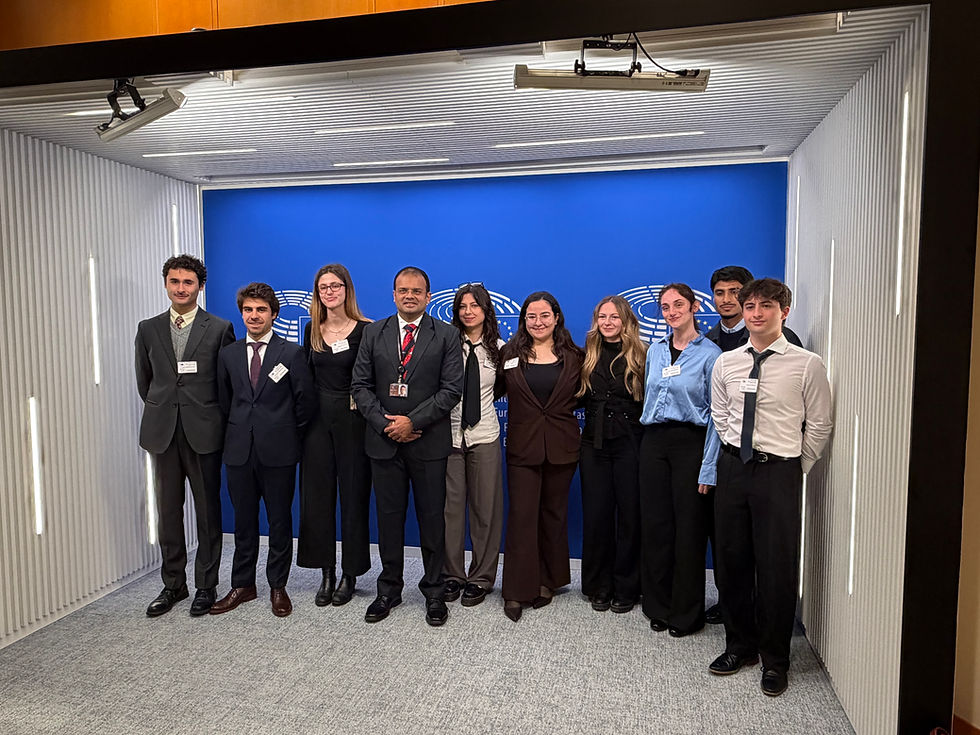
Held at a pivotal moment in EU–India relations, the conference focused on translating recent political and economic developments into practical pathways for cooperation. Discussions reflected the growing momentum generated by the landmark EU–India Free Trade Agreement, which is now entering a critical phase of review and implementation.
Speakers repeatedly highlighted that the partnership extends far beyond trade and is increasingly being framed as a broader strategic relationship built on shared values, democratic principles, economic resilience, and sustainable development.
The conference began with a formal address by EICBI Chair Sujit S. Nair, who highlighted the significance of the EU–India Free Trade Agreement and the need for forums such as this to advance closer and more meaningful cooperation. He emphasised that sustained, impactful discussions are essential to turning shared priorities into concrete partnership outcomes.
The EU Parliament session focussed on two topics - EU–India Free Trade Agreement: Opportunities, Challenges & Strategic Impact and Driving Sustainability: EU–India Collaboration for a Sustainable Future
EU–India Free Trade Agreement: Opportunities, Challenges & Strategic Impact
The first thematic session focused on “EU–India Free Trade Agreement: Opportunities, Challenges & Strategic Impact.” Participants examined the agreement’s implications for trade, investment, agriculture, logistics, manufacturing, and broader geopolitical cooperation.

Ms. Angelika Niebler, MEP from Germany and Chair – Delegation for Relations with India, said the timing was crucial, as the EU–India Free Trade Agreement negotiations had concluded in January and the agreement was now under review by the European Parliament.
She emphasised that the partnership between EU and India should be seen as more than a commercial arrangement, describing it instead as a broader strategic relationship based on shared values and common interests. She also identified cooperation on climate change and energy security as important dimensions of the partnership and highlighted the need to strengthen people-to-people engagement.
Mr. Vladimir Prebilič, MEP from Slovenia and a member of EU Parliamentary Committee on Foreign Affairs, described parliaments as platforms for dialogue and exchange. He stressed that politicians have a duty to cooperate on behalf of their citizens and pointed to the broad consensus within the European Parliament on the strategic importance of EU–India relations. He noted that both the European Union and India serve as anchors of democracy and multipolar cooperation, and reflected that his visit to India provided an opportunity to witness the country's remarkable progress and growing global significance.
Mr. Sudhakar Singh, Member of Parliament of India, stressed that agriculture is deeply connected to livelihoods in India and it cannot be viewed solely through an economic lens. He advocated moving from competition to cooperation in agricultural trade, highlighted opportunities in sustainability, food processing, and value addition, and stated that Indian farmers recognise the importance of sustainable practices. He emphasised the importance of balancing greater market access with the protection of rural livelihoods, while ensuring that sustainability frameworks remain practical, inclusive, and responsive to the realities faced by farmers.

Mr. Cristian Terheș, MEP from Romania, framed the FTA within the broader principle of peace through prosperity. He highlighted the strategic importance of the India–Middle East–Europe Economic Corridor and discussed alternatives to vulnerable trade chokepoints such as the Suez Canal and the Strait of Hormuz. He also promoted the role of Romanian infrastructure, particularly the Port of Constanța and the Danube corridor.
Mr. Michael Saxl of the Austrian Federal Economic Chamber argued that an FTA is necessary and mutually beneficial. He noted India’s competitive disadvantage compared with countries already enjoying FTAs with the EU and identified automotive, machinery, and electronics as sectors with significant potential. He also pointed to the need for a level playing field and for managing regulatory differences and tariff barriers.
Mr. Andreas Schieder, MEP from Austria, said India has become more important for the EU economically in recent years. He stressed the need for supply chain diversification and resilience, identified railways, digitalisation, and green technologies as promising sectors, and noted that the global economy is shifting in ways that require adaptation.
Mr. Jean-Marc Fenet, former Minister-Counsellor at the French Embassy in India, reflected on the long negotiation process and said that last year everything accelerated for both internal and external reasons. He pointed to the importance of reaching an agreement between large markets that share democratic values, said the changing global environment helped push the process forward, and noted that investment-related issues and technical matters still need to be resolved.
Mr. Monish Pattipati, CEO of Ravi Hatcheries Group, explained that EU regulations, particularly on antibiotics, have historically limited exports. He said India’s aquaculture sector has developed significantly, but exporters still face high costs and logistical constraints, making improved access to EU markets an important future opportunity for high-quality Indian seafood exports.
This session which was moderated by Prof. Cristina Vanberghen, Senior Expert – European Commission, concluded that the future is not about tariffs alone but about trust, collaboration, and people-to-people connection, with trade serving as a strategic instrument for strengthening democratic partnerships, supply chain resilience, and regional stability.
Driving Sustainability: EU–India Collaboration for a Sustainable Future
The second major theme, “Driving Sustainability: EU–India Collaboration for a Sustainable Future,” examined how sustainability considerations can be integrated into trade, investment, agriculture, manufacturing, and digital infrastructure.

Mr. Asif Iqbal of the Indian Economic Trade Organisation described the EU-India agreement as a strategic necessity and a strong political signal. He said it will boost cooperation and innovation in technology, contribute to global stability, and support long-term resilience in supply chains, while also highlighting India’s market potential and demographic advantages.
Mr. Patrick Crehan, former EU Delegation Consultant, discussed cooperation in aviation biofuels and sustainable technologies. He said agriculture and farmers are crucial to the sustainability agenda and argued that finance, especially for small farmers, is the main bottleneck rather than technology. He also highlighted circular economy initiatives and stressed the need for regulation that is feasible and affordable for smaller stakeholders.
Mr. Ankit Jain of Thirumals Paper Arizona Private Limited challenged assumptions linking paper production directly to deforestation. He argued that climate concerns are universal rather than Europe-specific and called for awareness and capacity-building to support more informed market and policy decisions.

Ms. Karen Dumery of GoAct B.V. focused on the environmental footprint of data centres, especially their use of fresh water. She said that while international funds are increasingly interested in sustainable investment, larger data centres require more expertise in cooling systems and better long-term planning so that water resources are not diverted away from local communities.
Karthik Krishna of Evervantage Consulting LLP highlighted sustainable data centres as a major opportunity within the future EU–India economic relationship. As Indian and European data demand continues to grow, Indian-produced air-cooled, free-cooled and closed-loop water systems could allow digital infrastructure to expand while reducing pressure on freshwater resources.
On the other hand, Ms. Ricarda Redeker, Founder of Project Plastic Extension, cautioned that the FTA should not be viewed solely as a mechanism for increasing trade volumes. She emphasised the need to simultaneously rethink consumption patterns, circular economy models, value chains, and product lifecycles to ensure that economic growth is aligned with sustainability objectives.
The sustainability panel concluded that climate change is both a risk and an opportunity, and that the long-term success of the partnership depends on collaboration, innovation, and the responsible adoption of sustainable business practices.
This session was moderated by Ms. Kaveri Sinjhi.

Report Launch and Recognition
A key highlight of the conference was the formal release of the report “India–EU FTA: From Market Access to Strategic Economic Corridors,” developed by EICBI in partnership with Water & Shark. The report was officially launched by the participating Members of the European Parliament and the Indian Parliament.
The publication examines policy challenges, market access considerations, business opportunities, infrastructure requirements, and sectoral pathways emerging from the EU–India Free Trade Agreement. It also explores how the agreement can serve as a strategic instrument for strengthening supply chain resilience, economic security, connectivity, and sustainable growth across the wider Europe–India corridor.
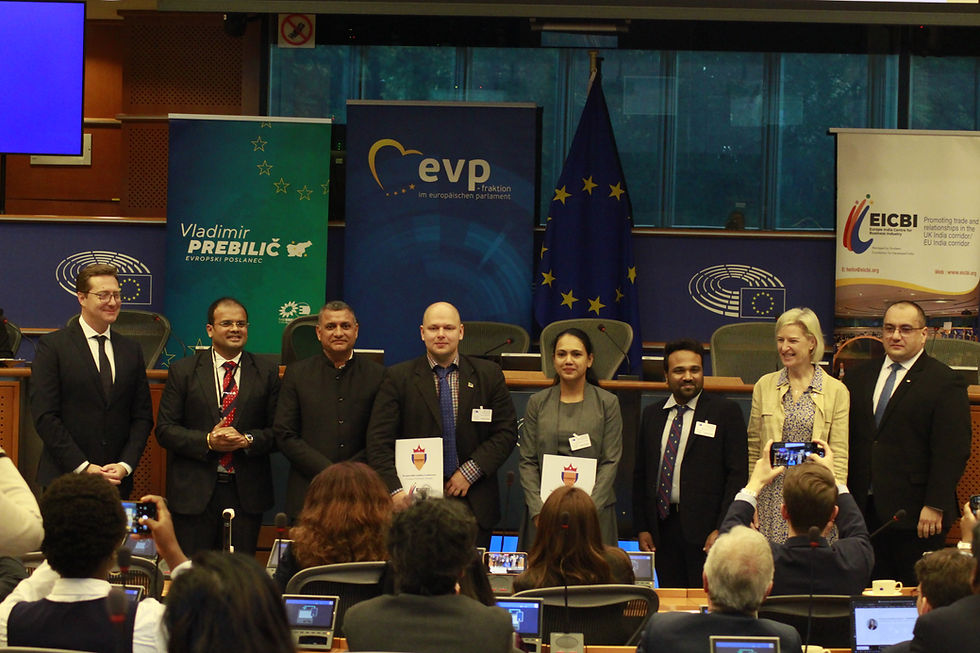
Organisers also recognised members of the 2025 Class of EuropeIndia40 leaders network, celebrating the contributions of emerging leaders who continue to strengthen engagement between EU and India/ wider Europe and India. The recognition reflected EICBI’s ongoing commitment to fostering the next generation of policymakers, entrepreneurs, professionals, and thought leaders dedicated to advancing Europe–India relations.
Session 2 - Invest in Austria: Bridging Opportunities Between India and Austria - The Styria Perspective
The conference also featured a special session titled “Invest in Austria: Bridging Opportunities Between India and Austria,” which provided participants with practical insights into Austria’s business environment, investment ecosystem, and role as a gateway to the European market. The session began with a welcome address by Silvia Fischer, Head of the Styria Office, who welcomed the delegation and highlighted the importance of strengthening economic engagement between India and Austria.

Participants then joined a virtual keynote by Karl Hartleb, focusing on India as a key focus country for the Internationalisation Centre Styria (ICS). The presentation highlighted Austria’s growing interest in the Indian market, the increasing opportunities for bilateral business cooperation, and the support mechanisms available to companies seeking to expand their activities between the two countries. The keynote was followed by an interactive question-and-answer session with participants.
The programme continued with a presentation by Cornelia Reibach-Stambolija, Austrian Trade Commissioner in Belgium, who outlined the role of ADVANTAGE AUSTRIA in facilitating trade, investment, and business partnerships. She highlighted opportunities for Indian companies seeking to establish a presence in Austria and Europe, while also showcasing Austria’s strengths in innovation, advanced manufacturing, technology, sustainability, and industrial cooperation.
The session concluded with a presentation by Sebastian Köberl from the EU Representation of the Austrian Federal Economic Chamber (WKÖ), who provided participants with an overview of the European Union’s institutional decision-making processes and the policy environment shaping business and investment across the EU. Together, the discussions offered valuable insights into investment collaboration, technology partnerships, market access, and knowledge exchange opportunities between India and Austria.
Session 3 - EU–India FTA Discussion in Partnership with India Salon Brussels
A dedicated EU–India FTA Discussion, organised in partnership with India Salon Brussels, was held on the same day in Brussels at Novotel Off Grand Place. The session commenced with an Opening Prayer in Sanskrit and a Lamp Lighting Ceremony led by Dipali de Beco, Co-founder of India Salon Brussels, followed by welcome remarks from Patrick Crehan.

The programme featured a series of impulse talks curated by Aksinya Staar. She spoke on a civilisational perspective on EU–India collaboration. This was followed by a talk on, “Beyond Tariffs and Transactions to Partnerships” by Patrick Crehan; EU market-entry strategies for Indian businesses by Sangeeta Vetal-Lad, and insights from an Indian business leader in Belgium, Peru Dharani.
This was followed by participant introductions by Aksinya Staar. The session reinforced the message that EU–India economic relations are evolving beyond tariffs and trade negotiations towards deeper, long-term partnerships built on sustainability, regulatory cooperation, innovation, and strategic collaboration.
Building a Resilient Partnership
Since 2011, EICBI has worked to strengthen EU–India and wider Europe–India relations through parliamentary engagement, policy dialogue, diplomatic outreach, business collaboration, and leadership initiatives. The conference reaffirmed the shared commitment of European and Indian stakeholders to building a resilient, forward-looking partnership that extends beyond trade.

It was encouraging to see policymakers, industry leaders, academics, civil society representatives, and emerging leaders come together once again to advance the next chapter of Europe–India relations.
Through dialogue, collaboration, and the exchange of ideas, the conference provided a valuable platform for shaping a more connected, sustainable, and prosperous future for both regions.
The programme concluded with networking sessions and stakeholder interactions, providing participants with opportunities to establish new partnerships and identify avenues for future cooperation across business, policy, research, innovation, and sustainability.
As EU–India relations enter a new phase of strategic and economic engagement, the conference underscored the importance of sustained dialogue and collaborative action in transforming shared ambitions into concrete outcomes that benefit both Europe and India.


Comments